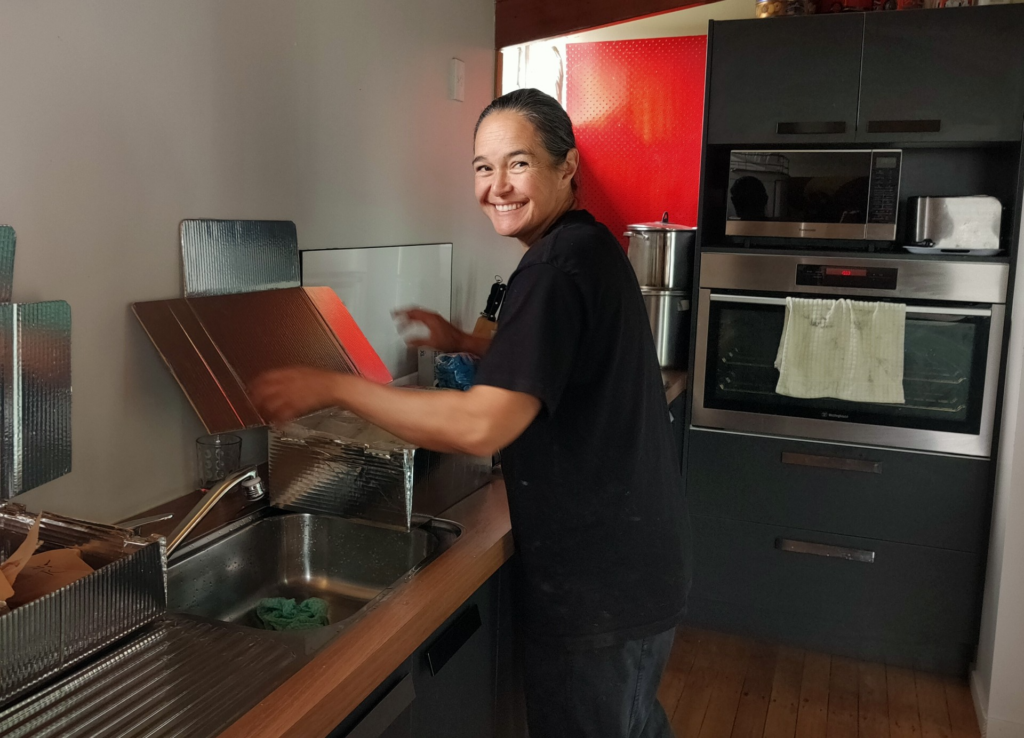

This week we were lucky enough to connect with local Midwifery Student, Emily Waaka (Pāhauwera, Ngāti Kahungunu). Emily talks to us about her decision to change her career and embark on her Midwifery degree. Her inspiring kōrero highlights the need for more Māori to take up the wero.
In 100 words or less, tell us about you. This could include whakapapa connections, your whānau, where you reside, your background and mahi which lead to your involvement in the hauora space.
Ko Emily Waaka ahau, he uri nō Pāhauwera, nō Ngāti Kahungunu hoki. I live in Waipukurau in Te Matau-a-Māui with my two tamariki, Mātai (7) and Evelyn (3 months), who are my why in everything I do. I’m a single māmā, currently on maternity leave before heading back into my third year of midwifery.
I’ve followed a few different paths, but they have always been centred around hauora, especially supporting wāhine. Starting my degree at 36 felt like a big decision, but it’s something I’m really proud of.
What inspired you to start your journey to become a midwife?
For me, midwifery wasn’t just a career choice, it was more of a quiet calling. I didn’t always think this was where my life was heading, but looking back, everything I had done seemed to lead me here. Once I started, it just felt right, like I was exactly where I was meant to be.
During the early years of my son Mātai, I was doing massage therapy from home as a way to keep working while raising him as a single Māmā. That eventually led me into mirimiri and romiromi, becoming part of a kaimirimiri rōpū and working with hapū Māmā during their hapūtanga. In those spaces, I saw how important it is for wāhine and whānau to feel safe, heard and supported. Those moments really stayed with me.
It made me want to walk alongside wāhine through the whole journey, including the birth of their pēpi, and gave me the confidence to step into midwifery.
How have you found juggling study, placements, and being a single Māmā?
It’s been one of the hardest, but most rewarding things I’ve done. Some days I don’t even know how I do it, just trying to stay organised and keep on top of study, manage placements, and still be present for my tamariki. This degree is like nothing else, with over 2400 placement hours across the four years, alongside the commitment, the hours of study, travel to Kirikiriroa for campus weeks, and time away from whānau, especially being on call during LMC placements, it can be a lot.
I wouldn’t be able to do any of it without my village. My parents and support network have held me up in so many ways, and that’s something I don’t take for granted.
I’ve also learned how important it is to look after myself, to make time for whānau and the things that fill my cup, and to give myself grace as a self-proclaimed perfectionist. Attending the Te Ara o Hine hui-ā-tau with other Māori midwifery students was really grounding and reminded me of my why. There are hard days, but I remind myself this is just a season.
What is your favourite thing about this journey? What keeps you going?
My favourite part of this journey has been the connections and the growth. In my first year, without even realising it, it brought me back to myself. It opened me up and made me question a lot of my own thoughts and beliefs. The relationships I’ve built along the way have been really special.
Being able to witness new life coming into the world, and the journey wāhine and whānau go through, is something I don’t take lightly. It’s such a privilege to be there alongside them and to support them in those moments.
What keeps me going is knowing why I started. On the hard days, I come back to that. And always, my tamariki. They are my biggest motivation and remind me what all of this is for.
We know that one of the challenges we face as Maori is that we don’t have a health workforce that reflects us. or a health system that meets our cultural needs. What have vour experiences been like as a Midwifery student within that system as a wāhine Maori?
As a wāhine Māori and midwifery student within the system, I’ve seen both the strengths and the inequities in our health care. There are moments where care is grounded in kaupapa Māori, where our hapū whānau are centred and tikanga is respected, and those moments feel really powerful.
I want to acknowledge our Māori midwives, our kaiwhakawhānau, who are already doing incredible mahi providing mana-enhancing, whānau-centred care. Māori midwives make up less than 10% of the workforce, which doesn’t reflect our population or the number of Māori pēpi being born. Their presence and impact is significant. They hold space for our hapū whānau in ways that honour whakapapa, wairua and tikanga, often within systems that weren’t built for us.
I’ve also seen non-Māori midwives who show up with humility, who are willing to learn and uphold tikanga in a respectful way, and that makes a difference too.
At the same time, inequities are still present. There are moments where our hapū whānau are not always heard, or where care doesn’t always reflect who we are. Being in this space as a student has opened my eyes to that, and it has strengthened my commitment to be part of the change and to support our hapū whānau in a way that uplifts their mana.
What advice do vou have for other Mãori who are considering a career in midwifery?
Take the leap. We need you. You don’t need to have everything figured out before you start. I started my degree at 36 as a single Māmā, and it was a big step, but one that felt right. It’s okay to start later, and it’s okay for life to happen along the way. I became pregnant during my second year, and it reminded me that even when things change, there is still a way forward. I’ve been able to take this time to be with my tamariki and will return to finish my degree next year. Bring who you are, your whakapapa, your values and your life experience, because that is what will make you a strong midwife.
Lean on your people, ask for help, and trust that you belong in this space. Our hapū whānau need care that reflects them, and you could be that for someone.
In our rohe, the amount of Māori hapū Māmā who have an LMC in their first trimester of pregnancy is shockingly low. Why do you think this is and what should we be doing to improve this? Do you also have any words of advice for Māmā Māori about choosing an LMC?
I think there are a few reasons for this. Access can be a challenge, especially in some areas, and not always knowing how or when to find an LMC plays a part too. For some, past experiences within the health system can affect trust, or whether they feel comfortable reaching out early.
I think we need to keep meeting our hapū whānau where they are. That means better access to information, stronger connections within our communities, and continuing to grow our Māori midwifery workforce, so care feels more relatable and culturally safe.
For Māmā Māori, my advice would be to take your time and find someone you feel comfortable with. You deserve to feel safe, heard and supported throughout your hapūtanga. Don’t be afraid to ask questions and remember that you have autonomy in your care. You can choose a midwife who aligns with you and your whānau, and it’s okay to change if it doesn’t feel right.
If you could change one thing for the wellbeing of Māmā Māori in our rohe, what would it be?
I would want to see consistent, ongoing support for our hapū whānau across their whole journey, so no one feels like they’re navigating things on their own or being left without the support they need.
From a midwifery perspective, that looks like continuity of care, building trust, and creating spaces where Māmā feel safe, heard and supported from the beginning and beyond. Care that is grounded in kaupapa Māori, where whānau are included and tikanga is respected.
For me, that’s what equity looks like, making sure our hapū whānau are supported in a way that truly meets their needs and upholds their mana.
What is your favourite whakataukī/whakatauāki/famous quote relating to health and wellness and why?
“He taonga te mokopuna, kia whāngaia, kia tipu, kia rea.”
This whakataukī really resonates with me, especially within midwifery and as a Māmā. It reflects how precious our pēpi are, and the importance of nurturing them so they can grow and thrive.
For me, that starts with supporting our Māmā and their whānau. When Māmā feel safe and supported, that flows through to their pēpi and the wider whānau.
Being a Māmā myself, I feel this even more deeply. It reminds me why this mahi is so important and the role we play in supporting Māmā, pēpi and whānau from the very beginning.